Key takeaways
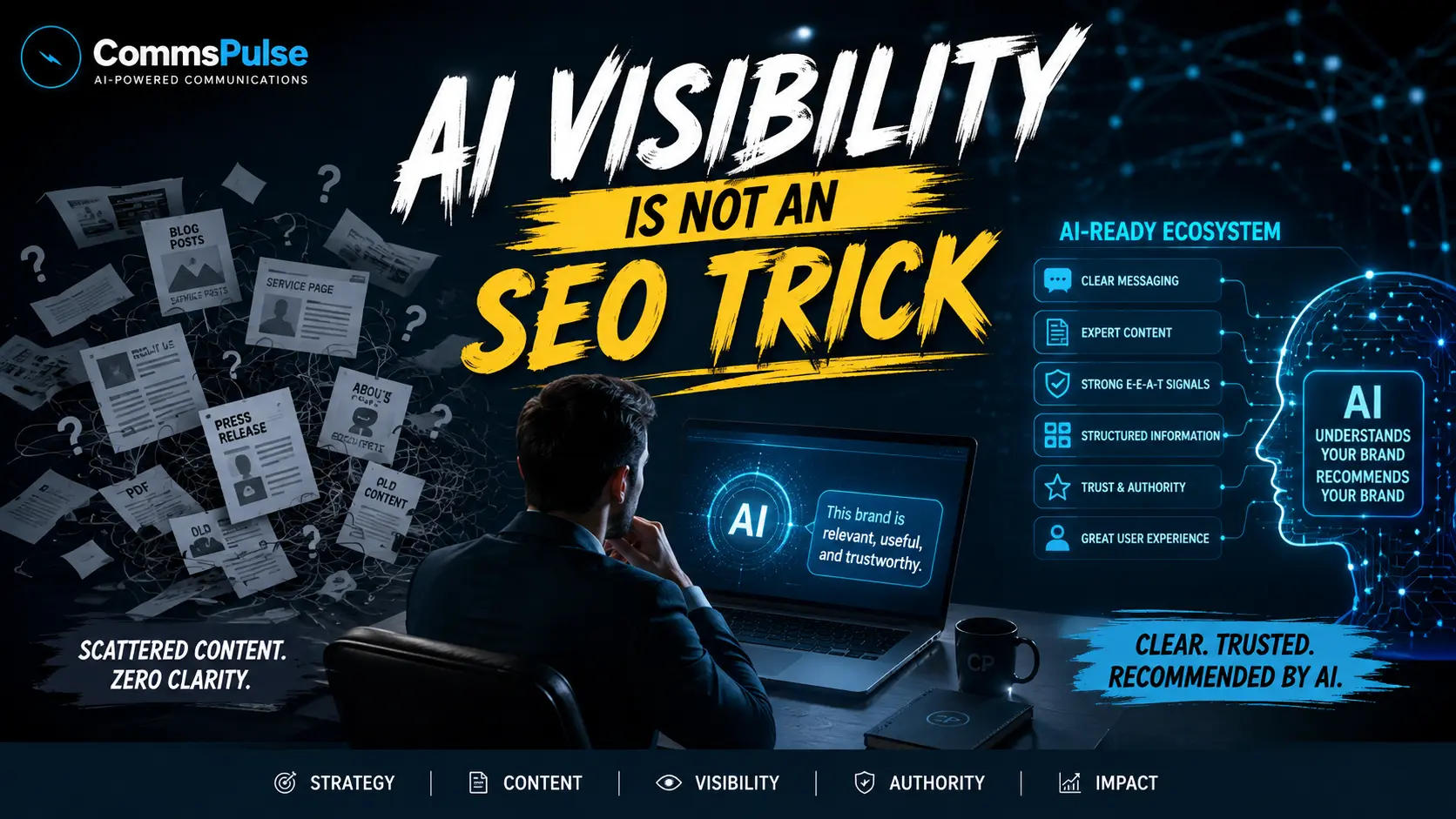
- AI visibility is not a separate hack sitting outside SEO, content, PR, and website messaging.
- Google continues to emphasize helpful, reliable, people-first content and high-quality original material.
- AI Overviews, AI Mode, and answer engines make clarity, structure, source trust, and entity consistency more important.
- Brands that publish vague, duplicated, or generic content become harder for both people and AI systems to understand.
- CommsPulse helps teams build clearer service pages, useful Insights articles, stronger internal links, and content structures that support discovery.
AI visibility is becoming one of the most misunderstood ideas in digital marketing.
Some teams treat it like a new SEO loophole. Some look for a technical trick that will push their brand into AI Overviews, AI Mode, ChatGPT answers, Perplexity responses, or other answer engines. Others think adding a few FAQs, repeating keywords, or publishing AI-generated summaries will make their website easier to cite.
That approach misses the point.
AI visibility is not about tricking machines. It is about making the brand easier to understand, evaluate, trust, summarize, and connect to a specific problem.
For founders, small teams, agencies, and communications departments, this changes the job. Content cannot only exist to fill a page. It has to explain the business clearly, answer real questions, show judgment, connect related topics, and create enough trust for both humans and systems to treat the brand as a useful source.
What AI visibility really means
AI visibility is the ability of a brand, website, or expert source to be discovered, understood, cited, summarized, or recommended by AI-assisted search experiences and answer engines.
That includes search environments such as Google AI Overviews and AI Mode, but it also includes the wider discovery layer where people use AI tools to ask questions, compare vendors, summarize industries, prepare buying decisions, understand categories, and shortlist service providers.
Google’s own Search Central guidance keeps the focus on helpful, reliable, people-first content. Google says SEO can be helpful when applied to people-first content, but content should not be created mainly to manipulate search rankings. Source: Google Search Central
That guidance matters because AI visibility does not remove the old quality standard. It raises it.
A vague page with thin explanations, no examples, weak internal links, and generic claims may still be indexed. But it gives search engines, answer engines, and readers very little reason to treat the page as useful.
Why shortcut thinking fails
The marketing industry has a habit of turning every new search shift into a tactic list. That is happening again with AI visibility.
The problem is that AI-assisted discovery is not solved by one element. It is shaped by many signals working together:
- clear page purpose
- useful headings
- original explanation
- entity consistency
- credible sources
- fresh context where needed
- internal links
- strong metadata
- page experience
- high-quality images and media
- brand credibility outside the page
Google’s Search ecosystem updates in 2026 also point in that direction. In its June 2026 update for website owners, Google said visibility in generative AI Search features benefits from unique, non-commodity content, good organization, strong page experience, and high-quality images and video. Source: Google Search Blog
That phrase, non-commodity content, should matter to every founder and marketing team.
Commodity content is easy to produce and easy to ignore. It describes common topics in familiar language without adding experience, context, specificity, proof, or useful structure.
AI visibility does not reward sameness. At least, no serious brand should build its strategy assuming that it will.
Search behavior is changing, but trust still matters
AI summaries are already affecting how users behave in search environments.
Pew Research Center’s 2025 analysis of Google users found that users were less likely to click on links when an AI summary appeared in the results. Pew also noted that many searches ended without a click regardless of whether an AI summary was present. Source: Pew Research Center
Semrush has also tracked the rise of zero-click behavior and AI Overviews. Its 2025 search analysis reported that zero-click search traffic had increased in the United States and that users were often finding answers directly through search features such as AI Overviews, featured snippets, knowledge panels, and other SERP features. Source: Semrush
For business websites, that can sound threatening. But it also clarifies the opportunity.
If fewer people click casually, the people who do click may arrive with stronger intent. That makes the page they land on more important. The page must explain the service, show credibility, answer the buyer’s immediate questions, and guide the next action without forcing the reader to decode the business.
Adobe’s 2026 AI and Digital Trends research points to the same broader shift. It frames AI as increasingly influential in the customer journey and highlights the need for brands to deliver transparent, trusted experiences as AI becomes part of how people research and engage. Source: Adobe
The AI visibility foundation
CommsPulse looks at AI visibility as a communication architecture problem.
It is not enough to have a blog. It is not enough to have service pages. It is not enough to add schema. Those pieces help, but only when the underlying content is useful, connected, and clear.
The CommsPulse AI visibility foundation
- Clear service identity: Every service page should explain what the service is, who it helps, and what problem it solves.
- Useful topical depth: Blog and Insights articles should answer real questions, not repeat generic definitions.
- Entity consistency: Brand, service, audience, and topic names should be used clearly across the site.
- Internal linking: Related pages should reinforce each other so readers and crawlers understand the topic cluster.
- Evidence and sources: Claims should be supported by credible research, official guidance, or practical experience.
- Machine-readable structure: Pages should use strong headings, metadata, alt text, schema, and clean HTML.
- Conversion clarity: Every useful page should guide the reader toward a natural next action.
1. Clear service identity
Many service websites use attractive language but weak definitions. They say they offer strategic support, growth solutions, creative execution, or full-funnel transformation. The words sound professional, but the buyer still does not know what happens after contact.
AI systems also struggle with unclear pages. If a service page does not define the service, audience, problem, deliverables, and related topics, it becomes harder to connect that page to a useful answer.
This is why AI visibility services should work closely with website copywriting and brand messaging and positioning.
2. Useful topical depth
A website needs more than sales pages. Service pages capture commercial intent, but Insights articles build the knowledge layer around those services.
For example, an AI visibility service page can explain the offer. An article like this explains the market shift, buyer pain, and practical foundation behind the offer. Another article can explain service-page structure. Another can explain internal linking. Another can explain how founders should create authority signals before relying on AI discovery.
Together, those pages create topical depth.
3. Internal linking
Internal linking is not decoration. It is how a site explains relationships.
An article about AI visibility should naturally link to SEO content services, content marketing, website copywriting, brand messaging and positioning, PR and media relations, and founder branding where relevant.
The reverse also matters. Relevant service pages should link back to the Insights article so Google can see the cluster from both directions.
4. Original value and human judgment
AI systems can summarize common knowledge quickly. That makes common knowledge less valuable as a publishing strategy.
Brands need more original value: practical frameworks, examples, decision logic, lessons from experience, original commentary, and sharper explanations of what the market is missing.
This is also why founder branding starts before the first LinkedIn post. If the founder has no clear proof or point of view, the company loses one of its strongest possible trust signals.
How CommsPulse fills the gap
Most small teams do not have an AI visibility problem in isolation.
They have a messy communication system. The website does not explain the offer clearly enough. The blog has no topic structure. Service pages do not link to each other. The founder has no public authority signal. PR, social media, content, and SEO operate separately. Metadata is weak. Images are missing alt text. The message changes from page to page.
That is why CommsPulse treats AI visibility as part of a wider communication system.
Depending on the brief, CommsPulse can support:
- AI visibility services
- SEO content services
- content marketing
- website copywriting
- brand messaging and positioning
- PR and media relations
- founder branding
- LinkedIn thought leadership
The goal is not to chase every AI search feature. The goal is to make the brand more understandable, trustworthy, and useful wherever discovery happens.
That is also why the CommsPulse model starts with a brief. One company may need service-page cleanup. Another may need a blog cluster. Another may need internal linking. Another may need founder authority, PR support, or clearer brand messaging before AI visibility work can make sense.
What teams should do next
The smartest first step is a visibility clarity audit.
Ask these questions:
- Can a first-time visitor understand what we do within 10 seconds?
- Do our service pages explain who we help and what problem we solve?
- Do our Insights or blog posts support our core services?
- Do our pages link naturally to related services and articles?
- Do we have useful, original explanations or only generic summaries?
- Are our images, metadata, headings, and schema doing their job?
- Does the site show enough trust for a serious buyer to take the next step?
If the answer is unclear, the website is not ready for AI visibility. It may be indexed, but it is not fully understandable.
That is the work worth doing.
Need to make your website clearer for search, AI, and real buyers?
Share your website, goals, audience, and current visibility challenge. CommsPulse will review the brief and recommend a practical AI visibility or SEO content package if the project is a fit.
Start a BriefFAQs
What is AI visibility?
AI visibility is the ability of a brand, website, or expert source to be discovered, understood, cited, summarized, or recommended by AI-assisted search experiences and answer engines.
Is AI visibility the same as SEO?
AI visibility overlaps with SEO, but it is not identical. It depends on clear content structure, entity clarity, original value, trust signals, page experience, topical depth, and content that is easy for both people and machines to understand.
Can adding FAQs improve AI visibility?
FAQs can help when they answer real questions clearly. They are not enough by themselves. Strong AI visibility also needs useful page structure, internal links, original explanations, credible sources, and clear service positioning.
How does CommsPulse support AI visibility?
CommsPulse helps brands clarify service pages, strengthen content architecture, add internal links, improve metadata, create answer-ready pages, build useful insights, and align messaging across PR, content, SEO, and website copy.
Research sources used
- Google Search Central: Creating Helpful, Reliable, People-First Content
- Google Search Blog: New Opportunities, Control and Insights for Website Owners
- Pew Research Center: Google Users Are Less Likely to Click When an AI Summary Appears
- Semrush: Is Zero-Click Search Traffic Increasing?
- Adobe: 2026 AI and Digital Trends Consumer Report
- Google Search Blog: How AI Mode and AI Overviews Help You Explore the Web