Key takeaways
- Founder branding is not the same as posting more often on LinkedIn.
- The strongest founder presence starts with positioning, proof, audience clarity, and a consistent point of view.
- B2B buyers increasingly rely on trust, networks, thought leadership, and human expertise before making decisions.
- AI can support content workflow, but founder authority still depends on lived experience, judgment, and credibility.
- CommsPulse helps founders turn experience into a structured public presence across LinkedIn, bios, website copy, interviews, and thought leadership.
Founder branding is often misunderstood.
Many founders think it begins when they decide to post on LinkedIn. They open a blank document, search for a few content ideas, look at what other founders are saying, and try to join the conversation. For a few weeks, the activity feels productive. Then the posts become repetitive, vague, or disconnected from the business.
The problem is not effort. The problem is sequence.
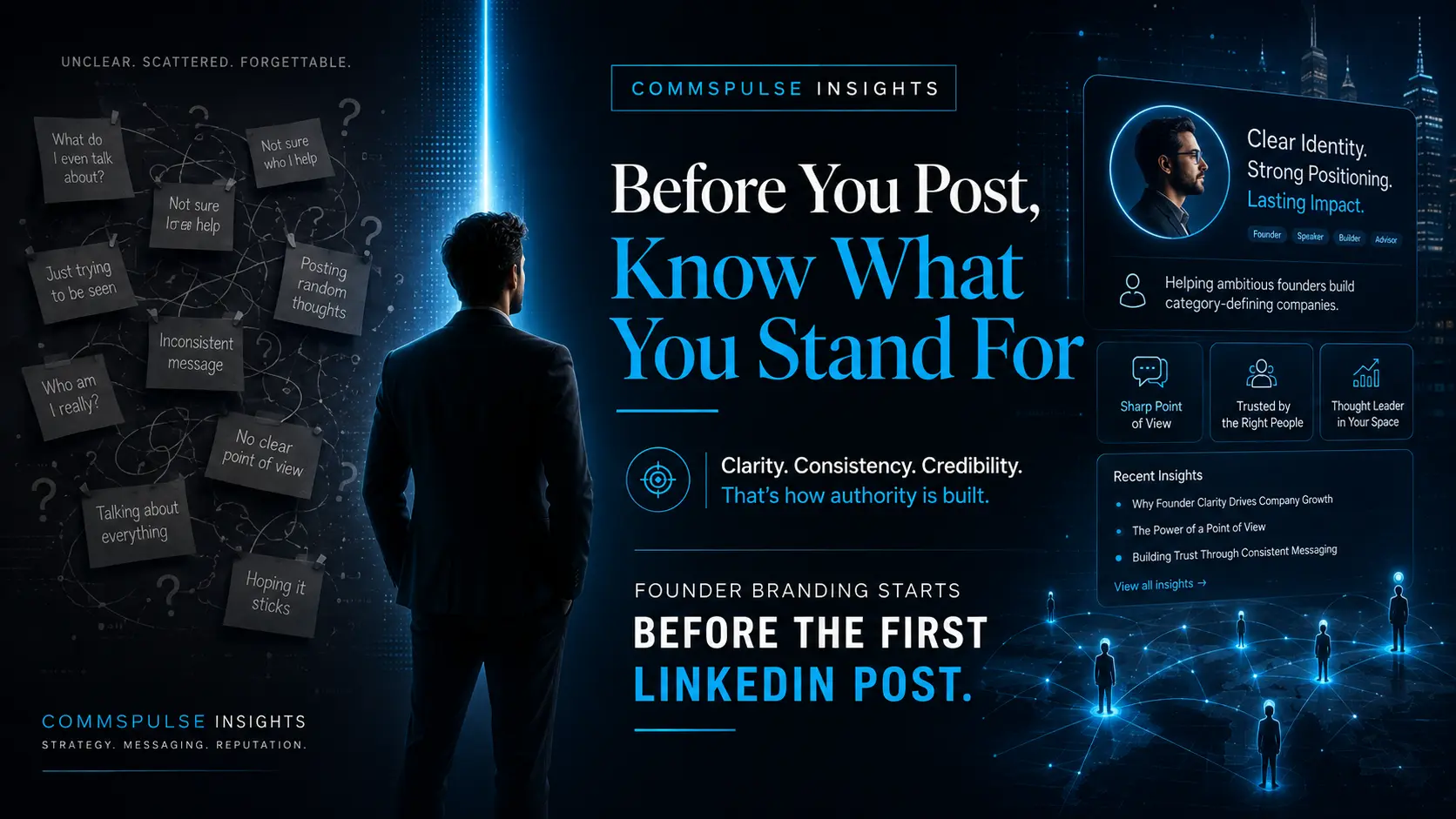
Founder branding does not start with a content calendar. It starts with a clear answer to a harder question: what should this founder be known for, and why should the right people believe it?
This matters because a founder’s public presence now affects more than personal visibility. It shapes investor confidence, buyer trust, hiring perception, partnership interest, media readiness, and the way people understand the company behind the person.
For founders, consultants, advisors, and senior leaders, LinkedIn is only the visible layer. The real work sits underneath.
Why founder branding matters more in the current B2B environment
B2B buying has become more complex, more social, and more trust-driven.
LinkedIn’s 2025 B2B Marketing Benchmark research frames trust as a central driver of brand building, especially as buying decisions increasingly involve groups, internal alignment, and social validation inside a category. Source: LinkedIn B2B Intelligence Hub
The Edelman and LinkedIn 2025 B2B Thought Leadership Impact Report also points to a deeper change. The report draws insights from nearly 2,000 global professionals, including visible and hidden decision-makers, and positions thought leadership as a strategic tool for building trust and opening doors where ads and traditional sales methods often fall short. Source: Edelman
This is why founder presence matters. The market does not only evaluate a company’s offer. It evaluates the clarity, judgment, credibility, and conviction of the people behind it.
That does not mean every founder needs to become a public personality. It means every founder who wants market trust should have a coherent public signal.
A founder’s public signal answers questions prospects rarely ask directly:
- Does this person understand the market?
- Can they explain the problem clearly?
- Have they lived the work they are talking about?
- Do they have judgment or only opinions?
- Can I trust this person with a serious business problem?
Those questions are especially important for service businesses, advisory firms, startups, agencies, consultants, and companies selling expertise rather than only products.
The mistake: treating LinkedIn as the strategy
LinkedIn is powerful, but it is not the strategy.
It is a distribution channel. It is a trust environment. It is a professional network. It is often the place where prospects, partners, journalists, investors, recruiters, and hidden stakeholders check whether a founder sounds credible.
But LinkedIn cannot fix unclear positioning.
A founder can post daily and still confuse the market. A consultant can write polished posts and still sound interchangeable. A startup CEO can share growth updates and still fail to explain the problem the company solves. An agency founder can publish strong opinions and still leave prospects unsure what the agency actually does.
The 2025 Sprout Social Index highlights a related issue in brand communication: consumers and teams are responding to noise, trend-chasing, and pressure for memorable social presence. Sprout’s research surveyed more than 4,000 consumers, 900 social practitioners, and 300 marketing leaders to explore changing expectations on social media. Source: Sprout Social
For founders, the lesson is simple. More activity does not automatically create more authority. Authority grows when repetition is connected to a clear identity, useful ideas, and consistent proof.
1. The founder sounds like everyone else
Generic hooks, familiar leadership lessons, recycled industry takes, and AI-polished wording make the founder sound active but not memorable.
2. The content attracts attention but not the right audience
Broad advice may get reactions, but it may not reach buyers, partners, investors, employees, or category peers who matter to the business.
3. The founder’s profile does not match the content
Someone reads a strong post, opens the profile, and finds an unclear headline, weak About section, no proof, and no obvious business relevance.
4. The content does not support a business outcome
Posts generate visibility, but they do not support conversations, credibility, referrals, media interest, inbound leads, or trust.
The founder branding foundation: what should exist before posting
A founder does not need a complicated personal brand manual. But the basics must be clear before a serious publishing rhythm begins.
The CommsPulse founder branding foundation
- Positioning: What should the founder be known for?
- Audience: Who needs to trust, follow, hire, fund, recommend, or partner with the founder?
- Proof: What experience, results, stories, systems, or decisions make the founder credible?
- Point of view: What does the founder believe that is useful, specific, and defensible?
- Content pillars: Which recurring themes support business relevance without becoming repetitive?
- Profile architecture: Does the LinkedIn profile explain the founder’s value quickly and clearly?
- Conversion path: What should the right reader do next?
Positioning comes first
Positioning decides the lane. Without it, the founder jumps between topics based on mood, trends, or visible engagement.
A founder in healthcare support may need to be known for patient access, claims coordination, cross-border assistance, hospital partnerships, and operational reliability. A founder in a communications business may need to be known for message clarity, content systems, editorial judgment, reputation-sensitive communication, and execution support.
The audience should be able to understand the founder’s authority within seconds.
This is why founder branding should connect naturally with brand messaging and positioning. The founder’s public story and the business story should reinforce each other.
Proof creates credibility
Founders often underestimate their proof because the experience feels normal to them.
Proof can include years of experience, unusual decisions, lessons from failure, clients served, industries covered, systems built, markets entered, teams led, launches supported, funds raised, crises handled, or operational problems solved.
Strong founder branding does not turn every detail into a boast. It turns selected proof into trust.
That proof can appear in LinkedIn posts, the profile About section, an executive bio, a media profile, a personal website, speaking notes, podcast introductions, investor-facing material, and company storytelling.
The point of view makes the founder worth following
Many founders publish information. Fewer publish judgment.
Information tells people what happened. Judgment explains what it means, why it matters, what most people miss, and what should happen next.
That is where LinkedIn thought leadership becomes different from regular posting. The goal is not to fill the feed. The goal is to make the founder’s thinking visible.
PRSA’s coverage of Muck Rack’s 2025 State of PR report found that, after media relations, PR professionals also focus heavily on thought leadership, measurement and reporting, and content creation. Source: PRSA
That matters because thought leadership now sits close to PR, content, social media, and executive communication. It is no longer a side activity for leaders with extra time. It is part of how credibility is built.
The profile must become a landing page
Many founders treat their LinkedIn profile like a resume. That is a missed opportunity.
A founder profile should work like a credibility landing page. The headline should explain the value clearly. The About section should create context and trust. The Featured section should point to useful assets. The experience section should support the story, not only list roles.
A strong post can bring someone to the profile. A weak profile can lose them.
This is where founder and executive communications, website copywriting, and content marketing begin to overlap. The founder’s words, website copy, and public thought leadership should sound like they come from the same strategic center.
Why AI makes founder voice more valuable, not less
AI has made it easier to create posts, headlines, captions, newsletters, and article drafts. That creates speed, but it also creates sameness.
Google’s guidance on helpful, reliable, people-first content makes the quality standard clear. Content should benefit people rather than exist mainly to manipulate rankings, and AI assistance does not remove the need for originality, usefulness, and reliability. Source: Google Search Central
LinkedIn’s own 2025 research on networks and trust also reinforces a human point: audiences do not only want information from brands, they want insight from people they trust to guide decisions. Source: LinkedIn News
That is the opportunity for founders.
AI can help structure ideas, test headlines, clean drafts, and build a content workflow. But the founder still needs the raw material that AI cannot invent honestly:
- lived experience
- specific judgment
- market scars
- decision stories
- client lessons
- operating beliefs
- clear conviction
Without those ingredients, founder content becomes smooth but forgettable.
With those ingredients, AI can support execution without flattening the founder’s voice.
How CommsPulse supports founder branding
CommsPulse does not treat founder branding as a vanity exercise or a posting service.
It starts with the business problem.
Some founders need better LinkedIn visibility. Others need investor-facing credibility. Some need a clearer founder story before a launch. Others need a stronger executive bio, speaker profile, media-ready positioning, website introduction, or content system that does not collapse after three weeks.
That is why the CommsPulse model starts with a brief.
Once the brief is reviewed, founder branding support can include:
- founder positioning strategy
- LinkedIn profile optimization
- founder bio and media profile
- personal website or founder page copy
- thought leadership pillars
- LinkedIn post strategy
- founder story development
- executive announcements
- interview and podcast preparation
- speaker profile and event bio
- media kit copy
- monthly content calendar
Depending on the founder’s goals, CommsPulse can connect founder branding with PR and media relations, media pitch writing, social media management, email and newsletter marketing, and AI visibility services.
The goal is coherence. The founder should not sound one way on LinkedIn, another way on the website, and a third way in a media bio.
What founders should do before writing the next post
Before writing the next LinkedIn post, founders should answer seven questions.
- What do I want to be known for in the next 12 months?
- Who exactly needs to trust me?
- What proof makes my point of view credible?
- What problem do I understand better than most people in my market?
- Which topics support my business direction?
- Does my LinkedIn profile explain my value quickly?
- What should the right reader do after engaging with my content?
If those answers are unclear, posting more will only add noise.
If those answers are clear, LinkedIn becomes much more powerful. The founder is no longer simply publishing. They are building a recognizable public authority system.
Ready to turn founder experience into authority?
Share your goals, audience, timeline, and current LinkedIn or public presence. CommsPulse will review the brief and recommend a practical founder branding package if the project is a fit.
Start a BriefFAQs
What is founder branding?
Founder branding is the process of turning a founder’s experience, point of view, proof, values, and business direction into a clear public presence that supports trust, visibility, and business credibility.
Why should founder branding start before LinkedIn posting?
A founder should clarify positioning, audience, proof, narrative, tone, and business goals before posting. Without that foundation, LinkedIn activity can become inconsistent, generic, or disconnected from business outcomes.
Is founder branding only for startup founders?
No. It is also useful for consultants, agency owners, advisors, executives, subject-matter experts, and business leaders whose credibility affects trust, hiring, media interest, partnerships, or sales conversations.
How does CommsPulse support founder branding?
CommsPulse helps founders clarify positioning, refine LinkedIn profiles, build thought leadership themes, shape founder stories, prepare executive bios, and create content systems aligned with business goals.
Research sources used
- Edelman and LinkedIn: 2025 B2B Thought Leadership Impact Report
- LinkedIn B2B Intelligence Hub and 2025 B2B Marketing Benchmark Series
- The 2025 Sprout Social Index
- PRSA: State of Public Relations, AI and Media Relations
- Google Search Central: Creating Helpful, Reliable, People-First Content
- LinkedIn News: Networks, Not AI or Search, Are the Trusted Source Amid Information Overload